The Hard Hat Era: Your 2026 AI Strategy Is an Org Chart
TL;DR
- The chatbot era is giving way to multi-agent ecosystems where AI "managers" oversee AI "workers," and you're designing an org chart, not a conversation
- The most successful AI products of 2026 won't have a chat interface at all. The UI is a notification, not a text box
- Multi-agent reliability comes at a cost: manager agents checking worker agents can double inference spend, and your pricing needs to reflect that
Between the release of Gemini 3 and the updates to Agent Lightning, the signal for 2026 is unmistakable: the single-turn, conversational interface is becoming legacy tech.
We spent 2024 and 2025 building chatbots. Some of them were impressive. Most of them hit the same ceiling: a text box is a bottleneck, and a single model trying to do everything is a reliability risk. The industry is now moving past that ceiling, and the direction it's heading has significant implications for how we build products.
Forrester is calling this the "Hard Hat" Era. The focus is shifting from wowing users with creative output to deploying multi-agent ecosystems that handle the boring, repetitive, grunt work in the background. Their strategic prediction: by 2028, 80% of customer-facing processes will be handled not by a single model, but by a hierarchical structure of AI managers overseeing AI workers.
If you're setting your product strategy for 2026, this is what that shift actually looks like in practice.
How does multi-agent design differ from prompt engineering?
In the chatbot era, we optimised prompts. We crafted system messages, tuned temperatures, built few-shot examples. The unit of work was the conversation turn.
In the agentic era, we optimise workflows. The unit of work isn't a prompt. It's a process. And the design challenge isn't writing better instructions for a single model. It's designing the structure of a multi-agent system. The handbook chapter on agentic AI patterns catalogues the architectural building blocks for this shift.
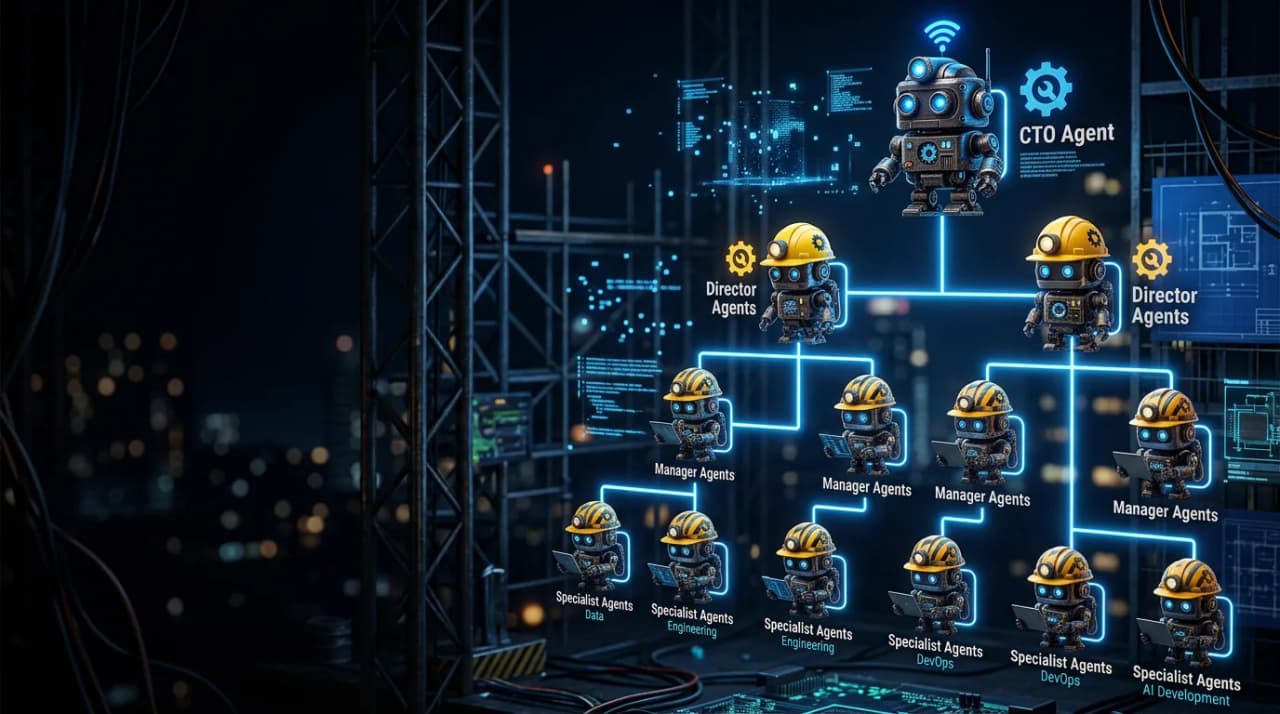
You are no longer designing a conversation. You are designing a digital organisational chart.
The architecture has two distinct roles:
The Worker. A small, fast, highly constrained model executing a specific SOP wrapped in code. "Extract invoice data." "Classify this support ticket." "Check this document against policy section 4.2." Workers are cheap to run, narrow in scope, and optimised for one task at high reliability. They're the equivalent of a junior analyst who does one thing very well and very fast.
The Manager. A large reasoning model (Gemini 3, GPT-5.2, Claude) that audits the worker's output, handles edge cases, and routes tasks. The manager doesn't do the grunt work. It reviews, decides, and escalates. When a worker flags an ambiguous invoice, the manager applies judgment. When a classification falls below a confidence threshold, the manager intervenes.
This mirrors how effective human organisations work. You don't have senior directors processing invoices. You have junior staff doing the volume work and senior staff handling exceptions. The same principle applies to AI systems, and for the same reasons: it's more reliable, more cost-effective, and easier to debug when something goes wrong. I built this kind of multi-model orchestration in production, routing different task types to different models based on cost-quality-latency tradeoffs.
Your job as a product leader is to define the reporting lines, not the prose. Which agents report to which? What are the escalation criteria? What quality thresholds trigger manager intervention? These are organisational design questions, not prompt engineering questions. And they require a different skillset than what most AI product teams have been building.

The rise of invisible AI
A prediction I'm confident in: the most successful AI products of 2026 won't have a chat interface at all.
Chat interfaces act as a bottleneck because they rely on human latency. Every interaction requires the user to formulate a request, wait for a response, evaluate the output, and decide what to do next. That loop is measured in minutes. For high-volume operational tasks, minutes are unacceptable.
The Hard Hat approach removes the human from the loop for the grunt work entirely. The agent operates in the background, doing what the SOP says, surfacing only exceptions and completions.
The old way: User asks the chatbot to check inventory levels. Chatbot replies with current stock. User asks the chatbot to draft a purchase order. Chatbot generates a draft. User reviews and submits. Three interactions, five minutes, full human attention required.
The new way: Inventory agent monitors stock levels continuously. When stock hits the reorder threshold, it triggers the procurement agent. Procurement agent drafts the PO based on vendor terms and historical pricing. Human gets a notification: "PO #4782 ready for approval. [Approve] [Review] [Reject]." One interaction, ten seconds, minimal cognitive load.
The UI is a notification, not a text box. The human's role is oversight and approval, not operation. This is what "agentic" actually means in practice: not a smarter chatbot, but a system that operates autonomously within defined boundaries and surfaces only what requires human judgment.
For product teams, this demands a fundamental rethink of what you're building. If your AI product roadmap is centred on conversational experiences, you're building the 2024 version of AI in 2026. The frontier has moved to ambient, invisible, operational AI that works while the user does something else.
The cost of reliability
The part that doesn't make it into the demo videos: multi-agent systems solve the reliability problem, but they threaten unit economics.
If you have a manager agent checking every output of a worker agent, you are effectively doubling your inference cost to buy reliability. The worker runs, the manager reviews. Two inference calls per task. For high-volume workflows (thousands of invoices, tens of thousands of support tickets) that cost adds up fast.
This is the engineering tradeoff at the heart of the Hard Hat architecture. You can run a single agent cheaply and accept the error rate. Or you can run a worker-manager pair reliably and accept the cost. The math depends on what failure costs you.
For a content suggestion feature, a 5% error rate might be acceptable. The user sees a bad suggestion, ignores it, moves on. The cost of failure is low. Running a manager agent to check every suggestion is overkill.
For a financial transaction or a regulatory compliance check, a 5% error rate is catastrophic. The cost of a single failure (a wrong payment, a missed compliance flag) far exceeds the cost of the manager agent's inference. Double the compute cost is a bargain compared to the risk.
Product leaders need to model this margin compression now, before they commit to multi-agent architectures. I've done the detailed math on the audit tax, and a manager checking every worker output can increase unit cost by 2,500%. The questions to answer:
- What does failure cost per task? If the answer is "not much," a single worker might be sufficient. If the answer is "a lot," the manager-worker pattern is justified.
- What's the volume? Manager overhead at 100 tasks per day is negligible. At 100,000 tasks per day, it's a line item on the P&L.
- Can you tier the oversight? Not every output needs manager review. Confidence scoring on worker output lets you route only uncertain results to the manager, reducing cost while maintaining reliability where it matters.
Reliability is a premium feature. Your pricing strategy needs to reflect the cost of that compute. If you're offering enterprise-grade reliability (manager-audited, exception-handled, governance-compliant AI workflows) that costs more to run than a basic chatbot. Price accordingly.
The 2026 playbook
The goal for 2026 isn't to build a smarter chatbot. It's to build a boring, reliable, invisible operation that works while you sleep.
That means:
- Design agent hierarchies, not conversations. Define workers, managers, escalation paths, and quality thresholds.
- Build for invisibility. The best AI UX is a notification that says "done" and an approval button. Not a text box.
- Model the economics. Multi-agent reliability costs more than single-agent speed. Know where the tradeoff makes sense for your use cases.
- Invest in monitoring. Invisible systems that fail invisibly are dangerous. Build the dashboards, the error logging, and the alerting before you deploy, not after. Your agent evals need to be infrastructure, not afterthoughts.
The companies that get this right will operate at a cadence that chatbot-era products simply cannot match. Their models aren't necessarily better. Their systems are designed for autonomous execution rather than interactive conversation. The Hard Hat era isn't glamorous. But boring, reliable, and invisible beats flashy, fragile, and interactive every time.
Frequently Asked Questions
How is a multi-agent hierarchy different from traditional microservices?
The architecture looks similar (specialised components communicating through defined interfaces) but the components are non-deterministic. A microservice returns the same output for the same input. An AI agent might not. This means the orchestration layer needs evaluation, confidence scoring, and fallback logic that traditional microservice architectures don't require. Think of it as microservices plus quality assurance built into every handoff.
Won't invisible AI create trust problems with users?
Only if you hide it. The key is transparent automation: tell the user what the system did, why, and what it needs from them. "We automatically reordered 500 units of SKU-4782 based on your restock policy. Approve or review." That's not hiding the AI. It's showing the AI's work and giving the human the final call. Trust comes from transparency and control, not from pretending automation isn't happening.
When should a product team start building multi-agent systems versus improving their single-agent setup?
When you've hit the reliability ceiling on a single agent for a workflow that matters commercially. If your single agent handles 90% of cases correctly and the remaining 10% are costing you customers, revenue, or compliance risk, that's the signal to add a manager layer. Don't add architectural complexity for its own sake. Add it when the cost of unreliability exceeds the cost of the additional compute.
Logan Lincoln
Head of Product based in Currumbin Waters, Australia. Led a $70M regulated B2B SaaS portfolio at Cotality, then founded OpenChair and took its product strategy from market entry into paid production use.