Physical AI Is Leaving the Browser
TL;DR
- AI started in the browser because text, code, and documents were the easiest surfaces to reach
- The next frontier is physical AI: robots, vehicles, sensors, warehouses, factories, medical devices, drones, and industrial workflows
- Product leaders need to learn hardware constraints, supply chains, safety cases, simulation, and edge inference because the browser-native AI playbook will not be enough
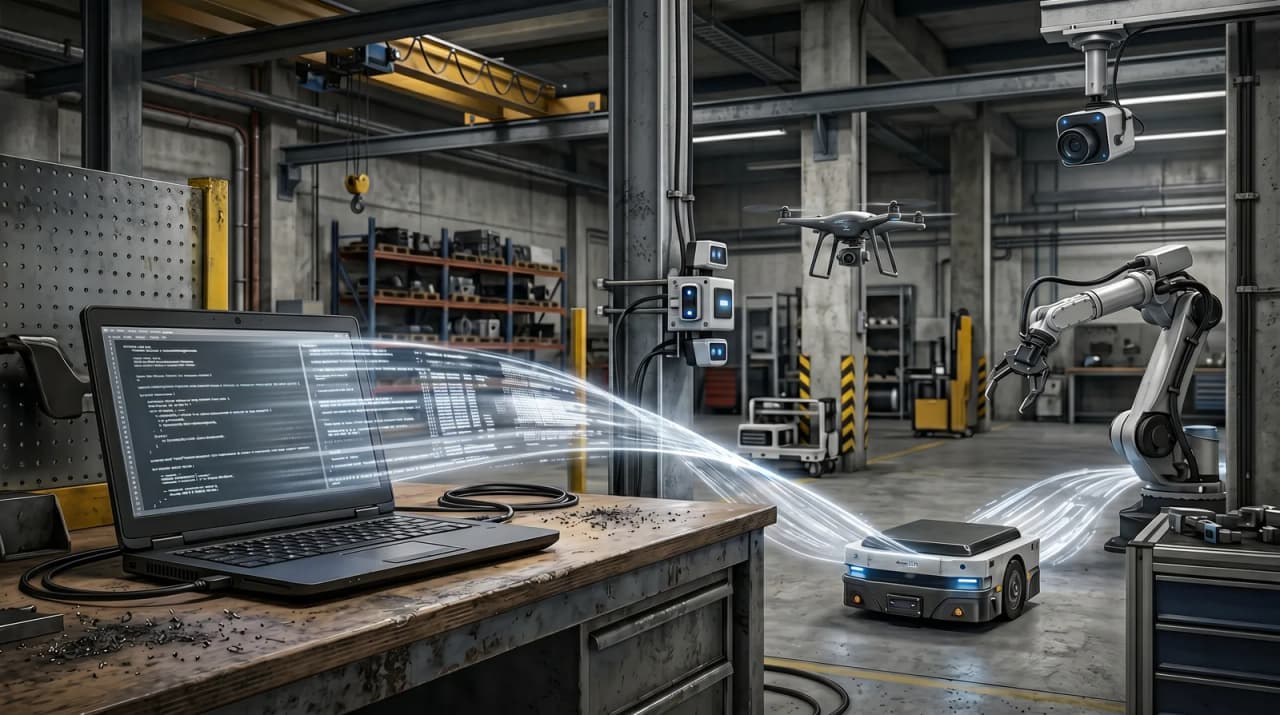
Physical AI is the next frontier after browser-native AI: models that sense, simulate, navigate, and act in the real world through robots, vehicles, drones, factories, sensors, and devices.
Chatbots, copilots, coding agents, document tools, research assistants, and workflow automations were the obvious first act because the substrate was already digital. Text in. Text out. Code in. Code out. API call in. Ticket updated.
That wave is not finished. It still has years to run. But the direction of travel is clear: once AI can reason across digital work, the valuable frontier moves into the physical world.
Robots. Vehicles. Sensors. Warehouses. Factories. Medical devices. Drones. Energy systems. Agriculture. Construction. Field service.
Physical AI is where models stop advising the world and start touching it.
That matters for product leaders outside robotics too. Property, banking, trades, healthcare, retail, logistics, and field service all have work that happens in rooms, vehicles, workshops, homes, and sites. I spent years around property, construction, valuation, and bank workflows where the digital record was only a proxy for physical reality. Physical AI narrows that gap.
The browser was the training ground
Browser AI taught the market four things.
First, natural language became a workable control surface. People could ask for work instead of clicking through nested interfaces.
Second, tool use changed AI from answer generation into action. A model that can call APIs, inspect files, query databases, and operate software is not just a chatbot.
Third, evaluation became a product discipline. If an AI system can act, teams need to measure correctness, refusal, cost, latency, drift, and failure modes.
Fourth, workflow ownership shifted. Product teams had to think about orchestration, permissions, handoffs, and human review, not just screens.
Those lessons transfer. The medium does not.
A digital agent can fail and retry. A robot arm can hit someone. A generated report can be corrected. A drone crash is an insurance claim, a safety incident, or worse. A browser workflow can be rolled back. A defective device in a customer's home becomes logistics, support, reputation damage, and margin loss.
Physical AI raises the cost of being casual.
Physical AI is already becoming infrastructure
NVIDIA is not subtle about where this is going. In 2025 it described manufacturers, industrial software companies, and robotics firms using Omniverse and robotics technologies to build AI-driven factories and autonomous machines. Its physical AI announcement names Toyota, TSMC, Foxconn, Caterpillar, Amazon Robotics, Figure, Agility Robotics, and others across factory digital twins, robotics, and industrial automation.
That is not a consumer gadget cycle. It is infrastructure.
The International Federation of Robotics reports that China already has around 2 million operational industrial robots, about 4.5 times Japan's stock, and that China accounted for 54% of annual industrial robot installations worldwide in the World Robotics 2025 data. IFR also warns that humanoid robots remain limited in real production settings, with broad adoption of AI in traditional industrial robotics expected over the next five to ten years.
That combination matters.
The physical AI shift is real. The humanoid hype is ahead of the deployment curve. Product leaders need to hold both thoughts at once.
Physical AI has different product physics
Software product managers are trained to love iteration. Ship. Measure. Learn. Roll back. Try again.
Physical products do not forgive that rhythm as easily.
Every physical AI product has constraints that browser-native teams often underestimate:
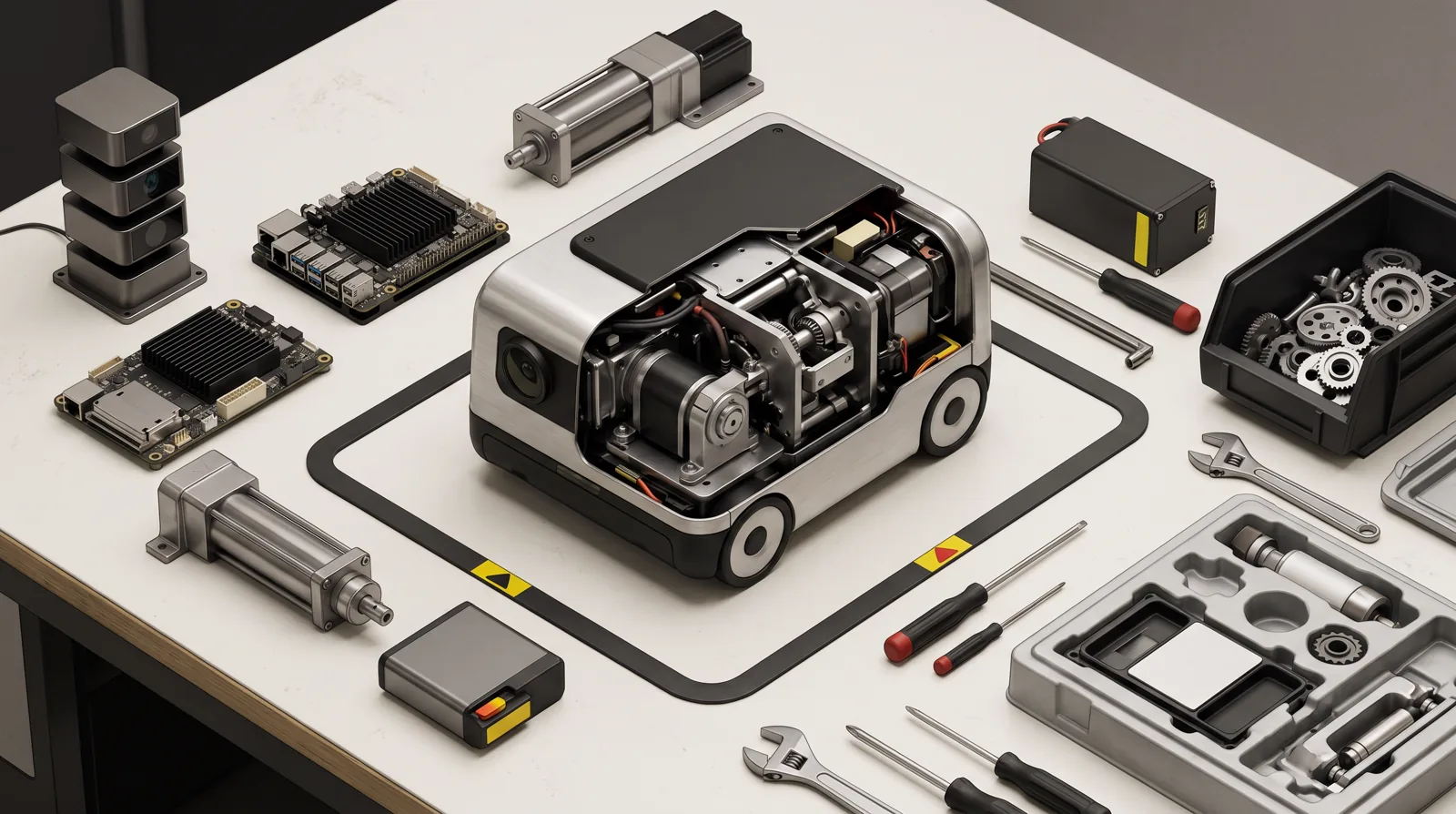
Supply chain. Cameras, sensors, batteries, actuators, chips, magnets, lenses, enclosures, thermal systems, connectors, and tooling all come from somewhere. Every supplier becomes part of the roadmap.
Manufacturing yield. A prototype that works once is not a product. A product needs repeatable assembly, tolerances, test fixtures, quality checks, repair paths, and acceptable return rates.
Edge inference. A robot, vehicle, or device cannot assume perfect cloud connectivity. Latency, heat, power draw, model size, and local compute change the architecture.
Safety. Digital products can be risky. Physical products add kinetic risk. Movement, force, heat, electricity, privacy, and environmental uncertainty all expand the duty of care.
Service operations. A failed SaaS feature gets patched. A failed device gets shipped back, repaired, replaced, or written off. Support becomes physical.
Regulation. Medical, aviation, defence, transport, workplace safety, consumer protection, and privacy regimes can turn a product decision into a compliance programme.
This is why the browser playbook breaks. Physical AI is not "SaaS with a body". It is a different operating model.
The first winners will be narrow
The market loves general-purpose robots because the story is easy to understand. A human-shaped machine walks into a human-shaped world and does human-shaped work.
The deployment path will be narrower.
IFR's analysis is blunt: traditional industrial robots outperform humanoids where high-speed, precision-driven, repetitive work is required. Humanoids may be useful where mobility and human-like interaction matter, but mass adoption as universal home or factory helpers is not a near-term outcome.
That matches the pattern from digital agents. General autonomy is a seductive demo. Bounded autonomy is what ships.
The first durable physical AI products will do specific jobs in constrained environments:
- Move materials inside warehouses
- Inspect defects on production lines
- Monitor safety zones in factories
- Assist technicians with guided repair
- Handle repetitive agricultural tasks
- Support elder care without pretending to replace carers
- Operate in defence and emergency contexts where risk tolerance differs
- Combine drone sensing with automated analysis for assets, crops, construction, and infrastructure
These products may look less exciting than a humanoid folding laundry. They will make money sooner.
I have made the same argument about boring agents that work. The physical version is even more important. In the real world, boring is not a style preference. Boring is how you avoid breaking expensive things.
Product strategy moves from interface to environment
Browser products mostly compete inside screens. Physical AI competes inside environments.
That changes discovery.
You cannot understand a warehouse from a journey map alone. You need to watch the loading dock at 5:30am. You need to know where dust collects, where Wi-Fi drops, where staff take shortcuts, which machine has a weird vibration, which process is officially documented but never followed.
You cannot design a care robot from personas. You need to understand fear, dignity, fatigue, family dynamics, liability, cleaning, maintenance, and what happens when the device behaves strangely at 2am.
You cannot build a field-service AI product by copying a support chatbot. The job happens in heat, rain, gloves, weak reception, under time pressure, next to machinery that may hurt someone.
Physical AI rewards product people who respect operations.
That is good news for vertical SaaS builders, industrial product managers, field operators, and domain experts. The next wave will not be won only by the teams with the best model wrapper. It will be won by teams that understand the worksite.
Distribution will matter more than demos
Physical AI has a harder distribution problem than browser AI.
Software can spread through a link. Hardware needs procurement, installation, training, maintenance, financing, insurance, spare parts, security review, and trust. Buyers need to know what happens when the thing fails.
That shifts advantage toward companies with:
- Existing operational footprint
- Field service networks
- Trusted customer relationships
- Access to proprietary environments
- Installation and support capability
- Regulatory competence
- Financing or usage-based commercial models
This connects to the broader AI moat problem. I have argued that your killer feature will be cloned by Friday. In physical AI, the feature may still be copied. The deployment network is harder.
The moat moves from model capability to the ability to make, deploy, service, and improve machines in the real world.
AI product leaders need a new literacy
Most AI product managers are improving their model literacy. Good. Keep going.
Now add physical literacy.
Learn the basics of sensors, actuators, edge compute, simulation, digital twins, latency budgets, safety cases, manufacturing yield, supply chain concentration, repair operations, and compliance. You do not need to become a mechanical engineer. You do need enough fluency to avoid making strategy decisions that collapse on contact with physics.
The AI boom is leaving the browser because the browser is only one surface where work happens.
The larger economy still moves through machines, buildings, roads, rooms, shelves, trucks, clinics, farms, homes, and factories. AI will not stop at summarising documents about those places. It will increasingly sense them, simulate them, navigate them, and act inside them.
The product leaders who understand that shift early will see opportunities that browser-only teams miss.
The ones who ignore it will keep building chat windows for work that happens nowhere near a keyboard.
Frequently Asked Questions
What is physical AI?
Physical AI refers to AI systems that sense, reason about, simulate, navigate, or act in the physical world. Examples include robots, autonomous vehicles, drones, industrial inspection systems, smart factories, medical devices, and sensor-driven automation.
Will humanoid robots be the main physical AI product?
Not in the near term. Humanoids are promising for environments designed around human bodies, but traditional industrial robots remain better for many high-speed, high-precision tasks. Narrow robots and physical AI systems in constrained environments are more likely to scale first.
Why should software product managers care about physical AI?
AI product strategy is moving beyond browser workflows. Product managers who understand physical constraints, operations, safety, and deployment will be better positioned as AI moves into warehouses, clinics, homes, vehicles, factories, and field service.
Logan Lincoln
Head of Product based in Currumbin Waters, Australia. Led a $70M regulated B2B SaaS portfolio at Cotality, then founded OpenChair and took its product strategy from market entry into paid production use.