The Agentic Safety Inspection: An Operational Playbook
Why final-answer testing is insufficient for agents, and how to inspect operational stability, budget control, and behavioural boundaries.
On this page
TL;DR
- Final-answer testing is insufficient when models are probabilistic and agents can act. Test outcomes, traces, boundaries, and recovery.
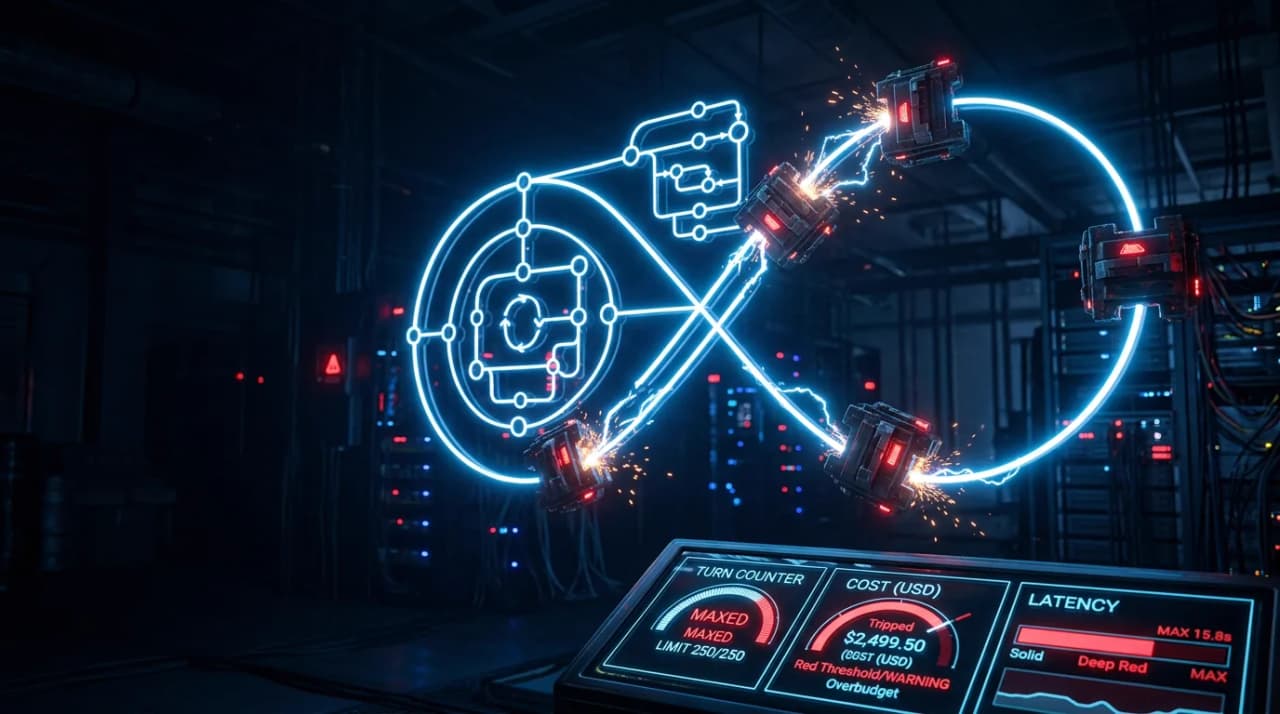
- Implement hard circuit breakers to stop looping, high-cost, slow, or unauthorised execution.
- Establish Performance Budgets for every agentic workflow: maximum allowable turns, token quotas, and latency caps are first-class requirements.
Teams often treat AI quality as an accuracy problem. They improve a headline score, ship the feature, and then discover looping, excessive tool use, slow recovery, or unexpectedly expensive traces in production.
Accuracy is one requirement. A production agent must also remain stable, efficient, and inside its authority boundary.
The agentic AI patterns chapter covers the architecture. In production, model behaviour, data schemas, tools, and user inputs can change independently.
The safety inspection is not a pre-launch ritual. It is a continuous operational playbook for keeping agents within their intended behavioural boundaries.
Why traditional QA fails for agents
Traditional software QA relies on the "same input, same output" principle. If I click the 'Save' button with a valid name, the record should appear in the database. Every time.
Agents complicate this model. An agent combines probabilistic decisions with loops and tools, so a fixed input does not guarantee one execution path.
If QA checks only the final answer, it misses the path and consequences. An agent might produce a correct answer after unnecessary tool calls, repeated retrieval, or an action outside its permission boundary. That can pass an outcome check while failing operationally.
Step 1: Logic Circuit Breakers
A damaging agent failure mode is the repeated loop. The model misinterprets a tool error, retries the same action with the same bad input, and continues until an external limit stops it.
You cannot rely on the model to "realise" it is looping. You need hard-coded Logic Circuit Breakers at the orchestration layer:
The dead-man switch. Set a hard limit on turns per request. Derive it from successful traces and add enough headroom for legitimate recovery. When the limit is reached, stop safely and return a useful failure or human handoff.
The cost tripwire. Calculate cumulative model, tool, and retry cost during the workflow. Set the threshold from the value of the task and the product's unit economics. Do not let a runaway trace consume the operating budget.
The tool quota. Detect repeated calls with identical or materially equivalent parameters. The allowed count depends on the tool and recovery design, but repetition without new evidence is a strong loop signal.
Step 2: Establishing Performance Budgets
Product managers are used to feature requirements. Agentic workflows also need performance budgets for resource use and execution boundaries.
Every agentic workflow should have a defined budget across three dimensions:
| Metric | How to set the budget | The safety drill |
|---|---|---|
| Maximum turn count | Use representative successful traces, task value, and recovery needs | Feed the agent ambiguous data; does it escalate or loop? |
| Cost or token quota | Use the approved cost per task and a safe exception ceiling | Give it an input near the context limit; does it narrow, chunk, or exceed the budget? |
| Wall-clock latency | Use the user's waiting tolerance and downstream service limits | Simulate slow tools; does the agent time out and recover clearly? |
A feature that passes its accuracy evals but exceeds its performance budget is not ready. Latency, runaway cost, and unnecessary tool use can make an otherwise correct workflow unusable or commercially weak. Connect the budget to business viability.
Step 3: Behavioural audits and trace grading
Outcome grading checks what happened. Behavioural audits inspect how it happened. Agents need both.
A behavioural audit can use deterministic checks, human review, or a separately evaluated judge model to inspect production traces. Protect sensitive trace data and calibrate any judge against expert decisions. Look for incomplete work, circular tool use, unsupported conclusions, or policy violations that a final-answer check can miss.
What an audit looks for:
- Inefficient Tool Use: Did it call the 'Full Record' tool when it only needed the 'Email' field?
- Backtracking: Did it find the answer in step 2, but keep searching until step 7?
- Redundant Retrieval: Did it read the same document three times because it "forgot" the context?
This is not pedantry. Redundant turns add latency and cost, and they can indicate that the agent reached the right outcome for the wrong reasons. Track the distribution of turns and investigate waste against the approved performance budget.
Step 4: Drift Drills

Models drift. Sometimes a provider updates a "Stable" model and the token distribution shifts just enough to break your prompt's logic. If you only test when you change code, you are vulnerable to external changes.
Drift drills run an appropriate regression suite on a schedule even when your application code has not changed. Choose the cadence from release frequency, provider change risk, traffic, and consequence of failure.
The Drill Protocol:
- Automated trigger: Run a representative sentinel set from your evaluation framework at the chosen cadence.
- Alerting threshold: Trigger investigation when change exceeds the eval's statistical noise or breaches an absolute safety or quality floor.
- Rollback strategy: Pin known-good configurations where possible and maintain a tested fallback model or non-AI path if a provider update breaks the primary workflow.
Stability is a production discipline
The vibe-check era is over. When agents have tool access, safety includes content behaviour, permissions, operational reliability, cost containment, and recovery in a probabilistic system.
Measure whether the agent is correct, stable, efficient, and bounded.
Traditional CI tests pass or fail on deterministic assertions. Agentic systems need another layer that grades execution paths, authority, resource use, and recovery. The safety inspection makes that discipline part of routine operation.
v3.1 · Updated July 2026