
TL;DR
- Consolidated four business units (Real Estate, Banking, Construction, Insurance) into a unified product function owning a majority of company revenue
- Built UX and Product Design capability from zero to six embedded designers
- Transitioned legacy engineering culture to outcome-based delivery squads and mentored two Senior PMs into leadership roles
The Problem
When I joined Cotality as Senior Product Manager in 2016, product management was a coordination function. No UX capability existed. Four business units operated independently, each with its own priorities, roadmap and relationship to engineering. Engineering operated in a project-delivery model: requirements in, features out, success measured by on-time delivery rather than customer outcomes.
The consequences were predictable. Duplicated effort across shared capabilities. Inconsistent user experiences across products. No portfolio-level view of investment allocation. And zero design capability anywhere in the organisation. Product managers wrote requirements documents. Engineers interpreted them. Nobody was responsible for the user experience.
The Approach
The transformation happened in three overlapping phases across multiple years: building the UX capability (creating something from nothing), consolidating the organisational structure (merging four silos into one function), and shifting the delivery culture (from project-based output to outcome-based squads).
None of these happened through a single reorganisation announcement. Each required sustained effort, executive sponsorship and proof points that the new model delivered better results than the old one.
Key Decisions
1. Embed Designers in Product Squads, Not a Central Design Team
The first UX hire could have gone either way: a central design team serving all products, or embedded designers sitting within product squads. I chose embedded. Central design teams create a service relationship where product teams submit requests and wait. Embedded designers build context, develop domain expertise and make tradeoffs alongside the PM and engineers daily.
We grew from zero to six designers across the portfolio, each embedded in a specific product area. The Head of UX reported into the product function, not a separate design department. Design quality, design consistency and design investment were product decisions, not negotiated service levels. I've since evolved this embedded model further for AI-augmented teams in the AI-native team design handbook chapter.
The results validated the model. RP Data's CSAT improved by more than 30%. Mobile DAU grew 730%. These outcomes required design thinking integrated into every sprint, not design reviews bolted on at the end.
2. Consolidate Business Units into a Unified Product Function
Four BUs meant four separate P&Ls, four sets of priorities and four competing claims on shared engineering resources. The consolidation merged all product roles (Group PMs, Technical PMs, designers) into a single function reporting to the CPO.
The unified function owned the portfolio-level investment view. For the first time, we could assess whether a dollar spent on Cordell Connect would generate more value than the same dollar spent on OnTheHouse. Resource allocation became a portfolio decision, not a political negotiation between BU leaders.
This also enabled portfolio-as-funnel thinking. OnTheHouse consumer traffic could feed lead generation. Lead generation could feed agent workflows. Agent workflows could feed advertising. Products that looked independent as separate BUs became connected when viewed through a single product lens. The unified function also made the RP Data platform rebuild possible, since that initiative required cross-BU coordination that the siloed structure could never have delivered.
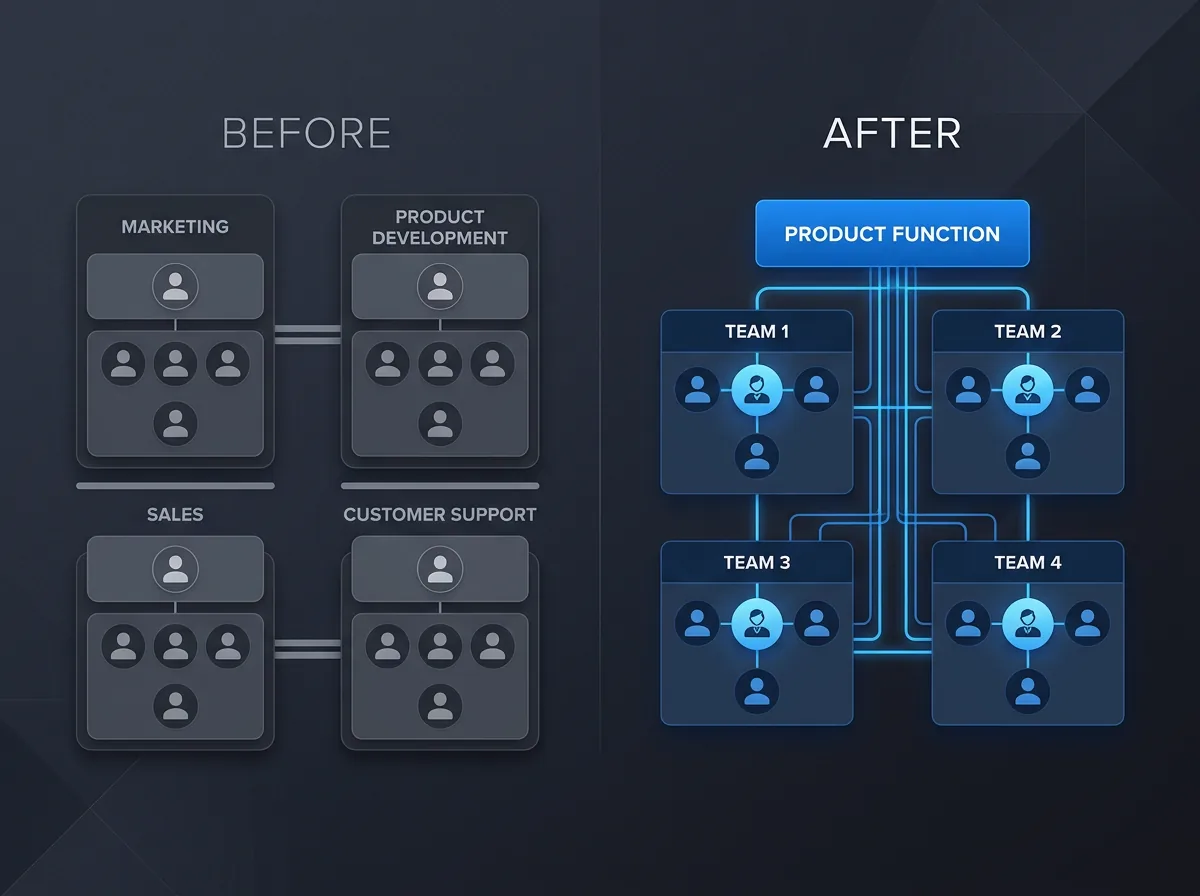
3. Transition Engineering from Project Delivery to Outcome-Based Squads
The legacy model measured success by whether features were delivered on time and on spec. If the feature shipped but nobody used it, that was a product problem, not an engineering problem.
Outcome-based squads changed the accountability model, following the empowered teams principles I now advocate broadly. Cross-functional teams (PM, designers, engineers) owned customer and business outcomes, not feature delivery. A squad responsible for "increase valuation ordering efficiency" had latitude to solve the problem however they chose, measured by whether ordering efficiency actually improved.
This transition required building trust incrementally. Early squads that demonstrated outcome-based success created the proof points for broader adoption. Legacy culture doesn't change with a memo. It took years.
4. Invest in the PM Leadership Pipeline
I focused on developing internal talent by mentoring Senior PMs and creating stretch opportunities that built leadership skills through real portfolio ownership.
Two Senior PMs I mentored moved into leadership roles within 18 months. They took ownership of sub-portfolios, managed stakeholder relationships independently and contributed to strategic planning. The product builder competency model I use codifies the skills I developed in these leaders: commercial thinking, technical fluency and customer obsession operating together. Growing leaders internally maintained cultural continuity during the transformation. New hires adopted the operating model from colleagues who had lived the transition, not from a playbook.
5. MAU-to-Seat Utilisation as the Unifying Metric
Enterprise SaaS products often track seats sold. That metric tells you about commercial success but nothing about product health. A client with 500 seats where 200 are active is a churn risk, regardless of what they're paying.
MAU-to-seat utilisation became the north star across the portfolio. It unified product, sales and customer success around a single question: are the people paying for this product actually using it? Utilisation above target benchmarks signalled healthy adoption. Below that threshold triggered investigation and intervention.
This metric also changed how we discussed pricing with banking clients. Conversations shifted from "here's what you'll pay" to "here's the value your teams are getting, and here's what unlocking the next tier enables."
Results
- Built UX and Product Design from zero to six embedded designers
- Consolidated four business units into a unified product function (a majority of company revenue)
- 21-person product organisation: Group PMs, Technical PMs, Head of UX, insourced and outsourced partners
- 8-product portfolio under single leadership with portfolio-level investment governance
- Transitioned engineering to outcome-based delivery squads
- Mentored two Senior PMs into leadership roles within 18 months
- Portfolio MAU-to-seat utilisation exceeded target benchmarks across enterprise accounts
- Significant CSAT improvement on flagship platform
Tech Stack
Cotality (CoreLogic) product organisation, enterprise-scale P&L, 8-product portfolio (RP Data, OnTheHouse, PropertyHub, ValConnect, Cordell Connect, Rita, Plezzel, GoVal/ValAssist), Tier 1 enterprise clients (CBA, NAB, ANZ), cross-functional delivery squads, portfolio-level investment governance